Hanasaka Castle
Overview
Hanasaka Castle is a medieval-style fortress built over 400 years ago, serving as the symbolic heart and spiritual pillar of Hanasaka City. The castle and the surrounding 1-square-kilometer Castle Park are owned and managed by the Castle Office (Hanasaka Castle Development Association).
Structure & Components:
Physical Structure and Layout
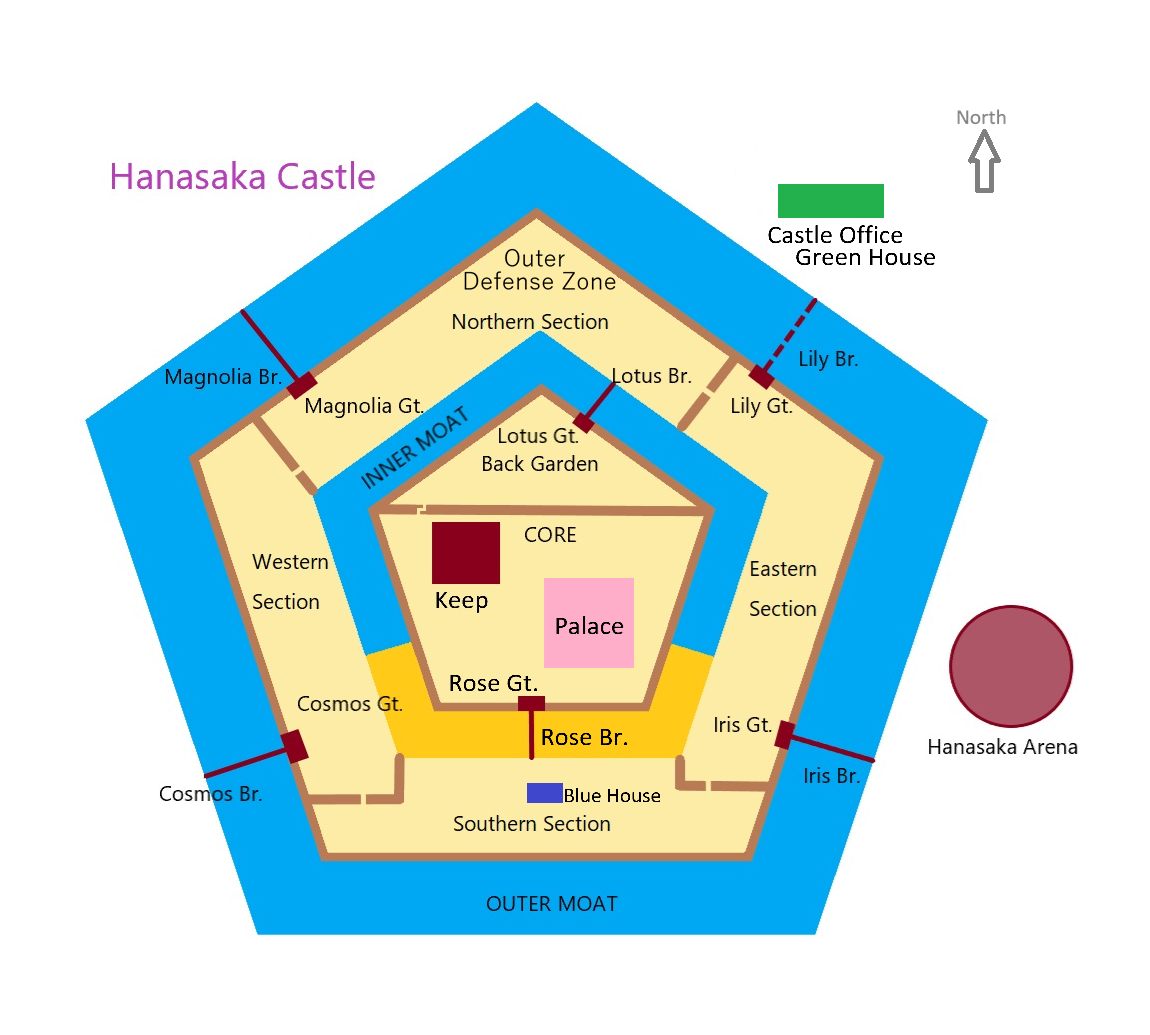
The castle features a sophisticated, multi-layered defensive design centered on a pentagonal central area. The layers, from outside to inside, consist of:
• Outer Moat: The outermost water barrier surrounding the entire complex.
• Outer Defense Zone (Angular Ring): A ring-shaped island between the two moats, divided into Northern, Southern, Eastern, and Western sections. Outer Defense Zone (Southern Section) contains the “Blue House”, the second official workspace for the Castle Office located just south of the Rose Bridge.
• Inner Moat: A water barrier surrounding the central area, designed to be higher than the Outer Moat. While most sections are filled with water, the area near the Rose Bridge is specifically maintained as a “dry moat” (empty of water). This intentional design creates a deep trench that can make enemy intrusion even more difficult than a water-filled section.
• Main Keep Area (Keep Area): The pentagonal core of the fortress.
Key Landmarks within the Castle
• Castle Keep (Keep): The icon of Hanasaka, a tower standing approximately 40 meters tall from its stone base. It serves as the ultimate stronghold.
• Palace: A reconstructed wooden building in the Main Keep Area consisting of four wings connected by corridors. It is used for ceremonies, tourism, and administration.
• Back Garden: A garden located in the northern part of the Main Keep Area, situated about 6 meters lower than the Palace.
Bridges and Gates:
Structure and Pairings: Hanasaka Castle is equipped with six bridges and six gates as its primary access points. These bridges and gates are designed in “pairs” sharing the same name; each gate is positioned exactly at the end of its corresponding bridge after crossing a moat from the outside.
Strategic Architecture: Many of the gates are constructed as reconstructed watchtowers featuring two-story corridors. This layout is a strategic defensive feature designed to force intruders to make a 90-degree turn after entering the first gate, thereby slowing their advance and making them vulnerable to attacks from the floors above.
1. Outer Moat Routes
These four routes provide access from the outside of the castle into the Outer Defense Zone (also known as the Angular Ring):
-
Magnolia Bridge & Magnolia Gate: Located in the Northwest (NW) of the castle.
-
Lily Bridge & Lily Gate: Located in the Northeast (NE). The Lily Bridge is a movable bridge that can be withdrawn to prevent entry during emergencies or at night.
-
Iris Bridge & Iris Gate: Located in the Southeast (SE).
-
Cosmos Bridge & Cosmos Gate: Located in the Southwest (SW).
2. Inner Moat Routes
These two routes provide access from the Outer Defense Zone into the Main Keep Area (Keep Area):
-
Rose Bridge & Rose Gate: The Main South Gate of the castle. Notably, the section of the Inner Moat near the Rose Bridge is intentionally maintained as a “dry moat” (empty of water) to make intrusion more difficult.
-
Lotus Bridge & Lotus Gate: The Rear Gate located in the Northeast. It is situated relatively close to the Lily Bridge on the outer perimeter.
Hidden Facilities
• Umber House (Castle Underground Base): A secret, high-tech underground facility located beneath the Palace. It houses the Princess Tree Hall and a terminal that allows direct communication with the super-intelligence Flora.
Map:
Castle Office
Overview
A private organization that develops and manages “Castle Park”, including “Hanasaka Castle”, and also hosts games for Kassen, a sport that originated in Hanasaka City. It is composed of multiple sections under four Directors, including the EIS (Equipment Inspection Section), CBS (Castle Building Section), ISS (Information System Section), GAS (General Affairs Section), and GAMS (Games and Arena Management Section).
Buildings:
The Castle Office owns the following facilities and buildings:
1. Green House
The main office building, the “Green House” (named for its distinctive moss-green roof), is located northeast of the Outer Moat, positioning it in close proximity to the Hanasaka Arena.
2. Blue House
A small, one-story wooden building characterized by its pale-blue tiled roof. It is located within the Southern Section of the Outer Defense Zone, situated at the southern end of the Rose Bridge. It serves as a temporary field office for the Castle Building Section (CBS) to oversee the ongoing restoration and construction work within the castle grounds.
3. Hanasaka Arena
Located just east of the castle’s Outer Moat, this stadium is the primary venue for Kassen matches. Built with white granite, its most striking feature is the four massive, petal-shaped outer walls known as “Petals”. These Petals are movable; they can slide to provide shade from the sun or close completely to form a dome during rain. The arena accommodates approximately 5,000 spectators, and the east stand offers a signature view of the castle keep and its stone walls as a backdrop to the matches.
The Board of Directors of the Castle Office:
The Board of Directors serves as the executive management of the Castle Office. The board consists of four founding Directors who have led the organization since its establishment. Beyond internal management, they form the “Kassen Representative Council” alongside the four Kassen Club Managers to make critical decisions for the Kassen community.
Here are the four Directors and their roles:
1. Monica
- Role: Responsible for general affairs, including human resources (HR), accounting, and workplace environment management.
- Section in Command: She oversees the General Affairs Section (GAS).
2. Prisha
- Role: Responsible for legal affairs, regulations, and information systems. As a former disciple of the late Haruna Laliguras, she possesses deep knowledge of the city’s core systems.
- Section in Command: She commands the Information System Section (ISS).
3. Lerhi
- Role: Responsible for public relations (PR), marketing/sales expansion, and the operations of the Hanasaka Arena. He is the uncle of Kasga Wisteria and was instrumental in appointing her as the Unifier.
- Section in Command: He oversees the Games and Arena Management Section (GAMS).
4. Haruki (Haruki Flinkas)
- Role: Responsible for castle restoration and management, as well as the maintenance and administration of Kassen Equipment. It is later revealed that he is the biological father of Haruna and Kasga.
- Sections in Command: He commands the Equipment Inspection Section (EIS) and the Castle Building Section (CBS).
Sections:
Equipment Inspection Section (EIS):
Formally known as the “Equipment Inspection Section,” this is one section within the Castle Office. Its primary roles include inspecting whether the Equipment used by Kassen Fighters during Kassen games is functioning correctly, as well as rewriting the HP recorded on Outfits according to the progression of the games.
Members:
- Julia: Section Manager
- Akio (until Chapter 3.19)
- Yugo
- Matilda
- Yoen
- Resilin
- Altan
Castle Building Section (CBS)
- Casto: Section Manager
- Polina
Information System Section (ISS)
- Suyuan: Section Manager
General Affairs Section (GAS)
Games and Arena Management Section (GAMS)
Kassen Representative Council
The Kassen Representative Council is the highest decision-making body for the Kassen community.
Composition
-
Original Members: The council originally consisted of eight members: the four founding Directors of the Castle Office (Monica, Prisha, Lerhi, and Haruki) and the four Kassen Club Managers from Hanasaka City.
-
Expansion: During the crisis in 9 E.E., the council voted to add Kasga Wisteria (the Unifier) as its ninth member. This was a significant shift, moving her from a purely symbolic figurehead to an active participant in critical decision-making.
Role and Functions
-
Decision-Making: The Council is responsible for making “critical decisions” for the Kassen community. This includes managing the organization of matches, handling significant administrative issues, and responding to external threats against the community or its leadership.
-
Confidentiality: It is a private, non-public body. Meetings are held in a secure, electromagnetically shielded room beneath the Castle Office’s “Green House” to prevent eavesdropping.
Operations
-
Convening: The council is convened by any of its members whenever an “important problem” arises.
-
Leadership: Meetings are traditionally presided over by the Castle Office Director in charge of general affairs, currently Monica.
Castle Guardians Association
The Castle Guardians Association is commonly referred to simply as the “Castle Guardians,” a security organization established by the Castle Office.